
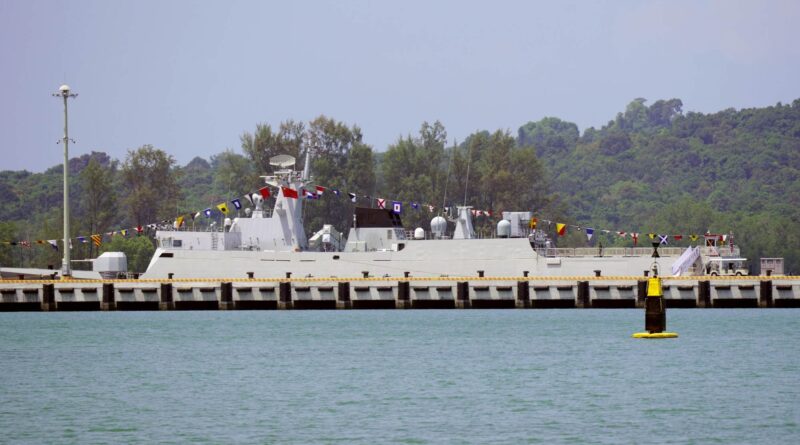
Cambodia flexes ‘agency’ in Japan ships’ visit to China-funded naval base
Port call shows Cambodia remains ‘open for cooperation’ with other nations and Ream Naval Base is not exclusively for China’s use, analysts say
Two Japanese minesweepers have become the first foreign military vessels to dock at Cambodia’s China-funded Ream Naval Base since its expansion – a move that is likely aimed at showing the facility is not “exclusively” for Beijing’s use amid continued scepticism over Chinese military access.
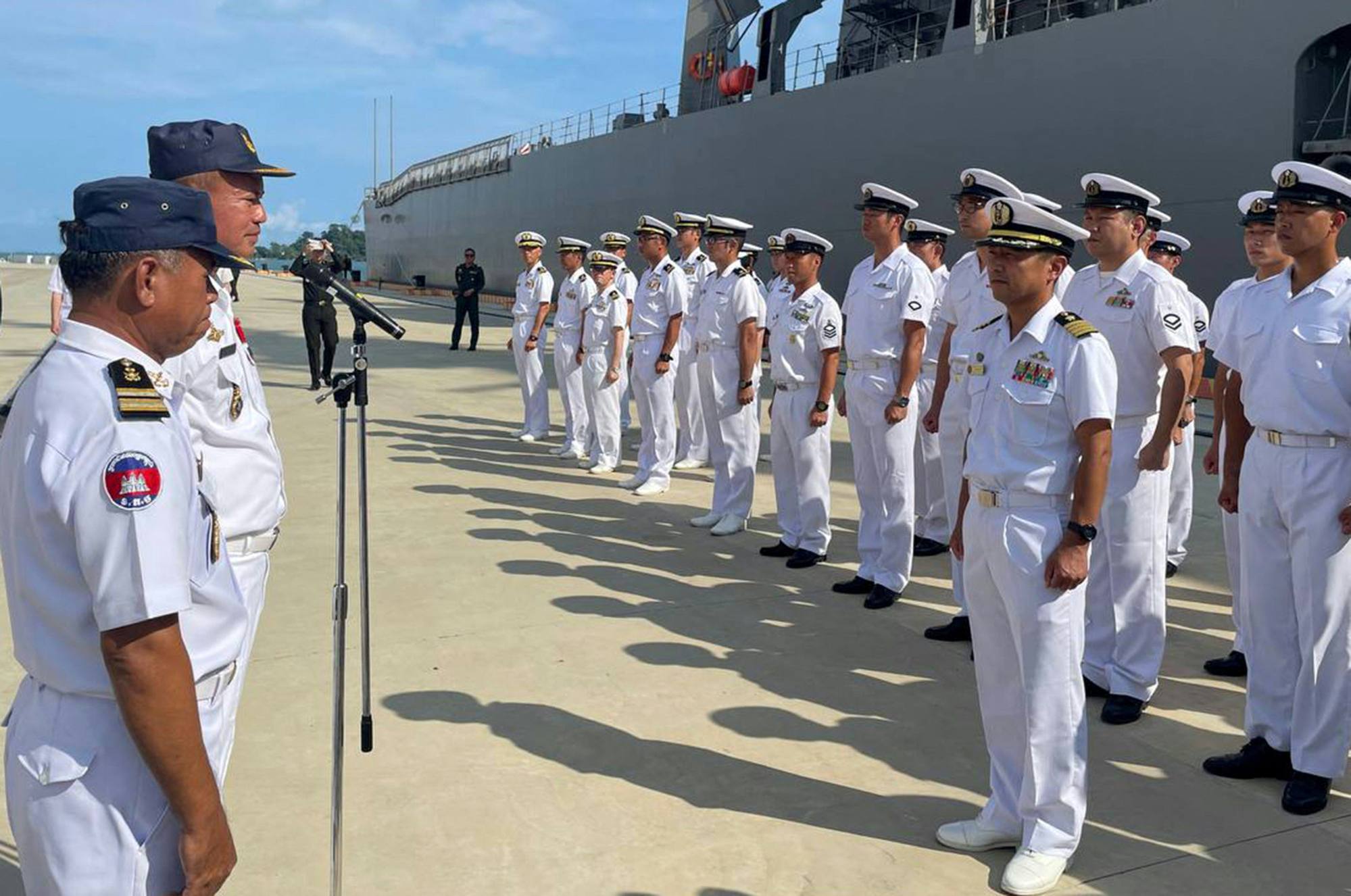
The visit by the Bungo and Etajima, both part of the Japan Maritime Self-Defence Force, began on Saturday and lasted for four days, bringing 170 sailors to the recently upgraded facility on the Gulf of Thailand.
Analysts said the port call was a symbolic but strategic signal from Phnom Penh that it retained control over the naval base, which had been at the centre of US concerns about China’s growing military footprint in Southeast Asia.
According to Shin Kawashima, an international relations professor at the University of Tokyo, Cambodia wants to emphasise that Ream will not become exclusively for the Chinese navy, and that sovereignty over the base remains with the kingdom.
He noted that the key test would be how often warships from other countries used the base and whether they were outnumbered by Chinese vessels. “If Chinese ships regularly outnumber foreign vessels by a significant margin, the claim that the port is ‘open’ would likely be met with scepticism from neighbouring countries,” Kawashima said.
Concerns over China’s role at Ream Naval Base surfaced in 2019, following reports of a draft agreement that would grant Beijing a 30-year lease allowing for the stationing of military personnel, weapons storage and warship access. Cambodia has denied the claims, but the United States has repeatedly voiced alarm over the issue.
The Japanese port call comes on the heels of a major expansion at Ream, widely believed to have been funded by China. Phnom Penh maintains that the base remains open to all “friendly countries” and has pointed to the Japanese visit as proof of its commitment to a non-exclusive policy.
For Japan’s part, Kawashima said Tokyo wanted to demonstrate that it shared the concept of a Free and Open Indo-Pacific (FOIP) with Cambodia.
Introduced by former Japanese prime minister Shinzo Abe and formalised as a strategy in 2016, the FOIP is aimed at promoting the rule of law, freedom of navigation and free trade.
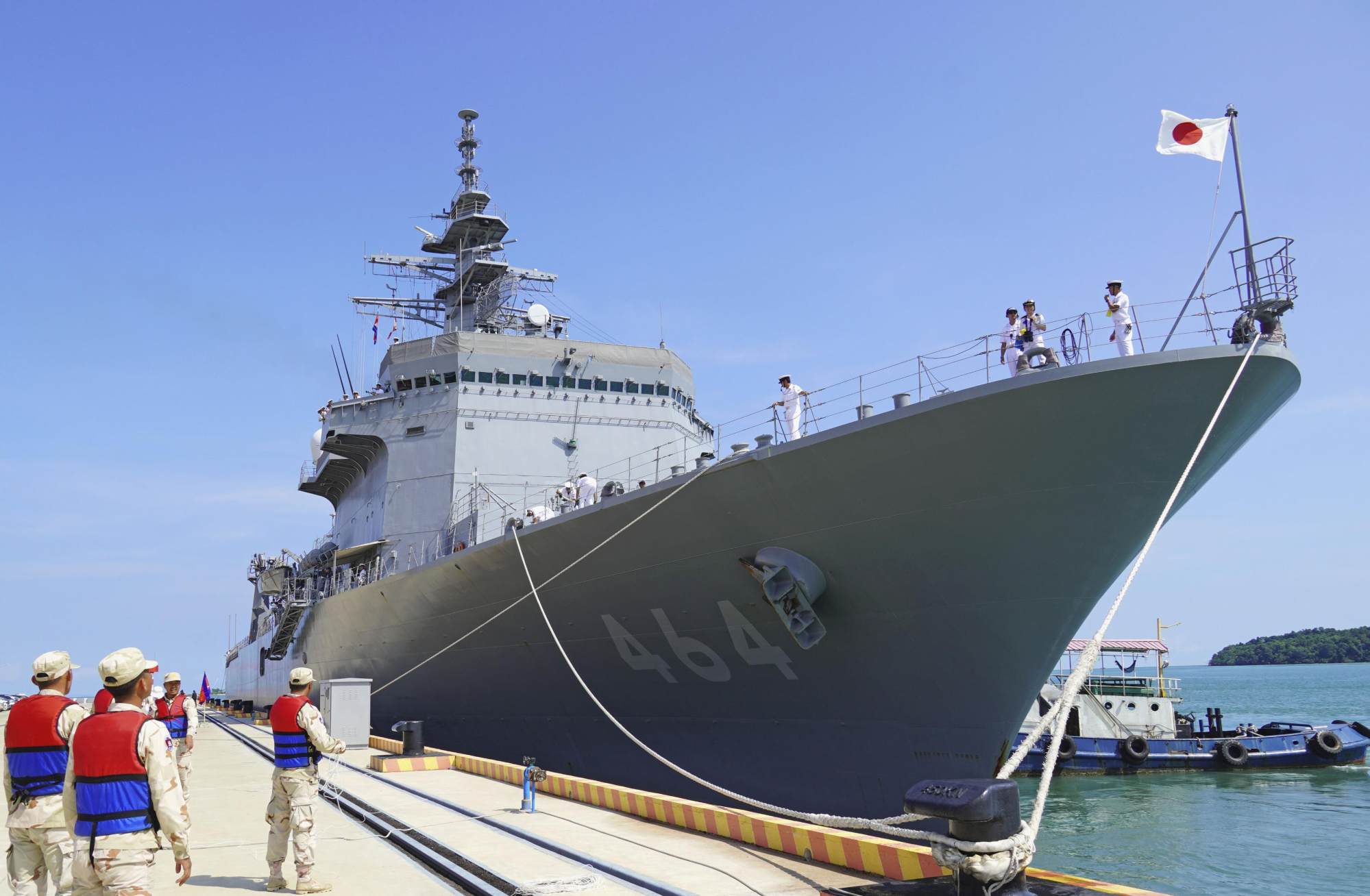
Kawashima noted that port calls were “an extremely effective means” of gaining insight into the Ream Naval Base, and the choice of mine-sweeping ships rather than escort vessels was Japan’s way to avoid conveying the message that it was “militarily countering” China.
“The [move] was likely intended to convey the meaning of activities for international contribution or training for such purposes,” he added.
Chhay Lim, a research fellow at Cambodia’s Institute for International Studies and Public Policy’s Centre for Southeast Asian Studies, described the arrival of the Japanese vessels as a meaningful moment in Cambodia-Japan ties.
“[It] sends a strategic message [that] Cambodia is open for cooperation beyond just China,” Lim said.
While one visit would not erase deeper concerns about possible Chinese military access, Lim said it still helped Phnom Penh “show that it still holds the pen in shaping its defence relationships”.
The foreign policy recalibration under Prime Minister Hun Manet, who assumed leadership in 2023, also indicated a “more deliberate effort to keep partnerships diversified” and that Cambodia “retains agency over how the country engages with its partners”, Lim said.
Citing the Khmer saying “we do what’s best for ourselves, let others think what they want”, Lim noted that the Japanese vessels’ visit was about reminding the world that Cambodia still had “room to manoeuvre, and intends to keep it that way”.
In light of the unpredictable US policy under the Donald Trump administration, Lim said Japan understood that countries in the region were increasingly worried about a riskier world.
“It is a good time for Tokyo to project itself as a steady, predictable, and non-threatening partner in the region,” Lim said. “Japan has always played the long game in Southeast Asia, and this visit shows it is willing to quietly step into complex spaces without making too much noise.”
The Japanese vessels arrived one day after Chinese President Xi Jinping’s two-day state visit to Cambodia last week.
Apart from highlighting China’s “ironclad” friendship with Cambodia, Xi last week called on the kingdom to “resist protectionism” and “oppose hegemonism”. The two countries also signed 37 documents during Xi’s visit, including on investment, trade and finance.
China, a close partner of Cambodia and also its largest creditor, has in recent years invested billions of dollars in projects in the kingdom, including roads and airports.
In recent years, Tokyo has also strengthened ties with Cambodia in what is widely seen as an attempt to offset Beijing’s influence in the region.
A statement on Saturday from Japan’s embassy in Cambodia said the two vessels were on a mission that began in January to 11 countries across Africa, the Middle East, South and Southeast Asia.
Kawashima said Japan was also concerned about the suspension of projects by the US Agency for International Development under the Trump administration that had led to anxiety among many developing countries in the region.
Tokyo must collaborate with other US allies and like-minded countries to address how to respond to such changes and mitigate concerns about Washington’s withdrawal, he added.
“The recent port call by the Japanese Maritime Self-Defence Force at Ream’s port likely carries such significance,” Kawashima added.
More Articles from SCMP
6 universities in Hong Kong make Asia top 50 for first time since 2017
Trump ‘panicking’ over tariffs, China’s biggest warships on show: SCMP daily highlights
Alexis Badel tunes up for Champions Mile bid with breakthrough treble at Happy Valley
European Parliament in ‘final stages’ of talks with China to remove sanctions on lawmakers
This article originally appeared on the South China Morning Post (www.scmp.com), the leading news media reporting on China and Asia.
Copyright (c) 2025. South China Morning Post Publishers Ltd. All rights reserved.